
Best eSIM for International Travel

Reading Time: 7 minutes
The best eSIM for international travel depends on your destination, trip length, data usage, and whether you need hotspot, calls, texts, or a local number. There is no single provider that is objectively best for every traveler. Current 2026 comparisons commonly feature Airalo, Holafly, Saily, Nomad, and Ubigi, but their plan structures differ enough that the right choice can change from one trip to another.
For most travelers, start with coverage rather than price: make sure every country on your itinerary is included, then compare data, validity, network access, hotspot rules, activation timing, and support. This is more reliable than choosing a provider simply because it advertises the lowest starting price.
What Is an eSIM for International Travel?
An eSIM is a digital SIM profile that lets a compatible device connect to a mobile network without inserting a physical SIM card. A travel eSIM is usually purchased before or during a trip and can provide prepaid mobile data in another country or region. Apple confirms that travelers can use existing carrier roaming, purchase a local eSIM, or use a worldwide travel eSIM provider.
Many travel eSIMs are data-only. You can still use WhatsApp, iMessage, FaceTime, email, maps, and other internet-based services, while your primary SIM can remain available for calls or texts if your phone and carrier support dual-SIM use.
Best eSIM Providers for International Travel
Instead of treating one brand as the universal winner, compare providers according to the travel scenario they are designed to handle. Current provider information and 2026 comparison pages show meaningful differences in coverage, plan format, unlimited-data options, hotspot policies, and app features.
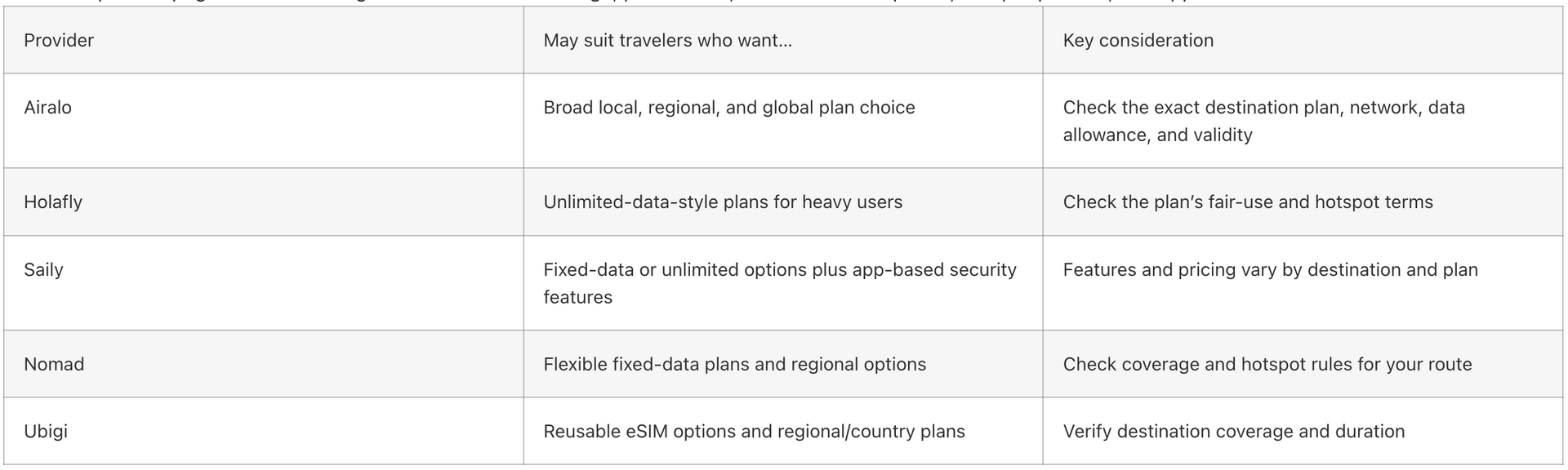
Airalo currently advertises local, regional, and global eSIMs across 200+ locations, with both fixed-data and unlimited options in its global offerings. Holafly currently promotes unlimited-data travel plans across 200+ destinations, but travelers should review the individual plan’s conditions, particularly hotspot provisions.
How to Choose the Best International eSIM for Your Trip
1. Check every country on your itinerary
A country eSIM may work well for one destination but become inconvenient if you cross borders. For multi-country travel, compare regional or global plans and confirm that every stop is covered. Do not assume a plan labeled “Europe,” “Asia,” or “Global” includes every place you intend to visit.
2. Match the plan to your data usage
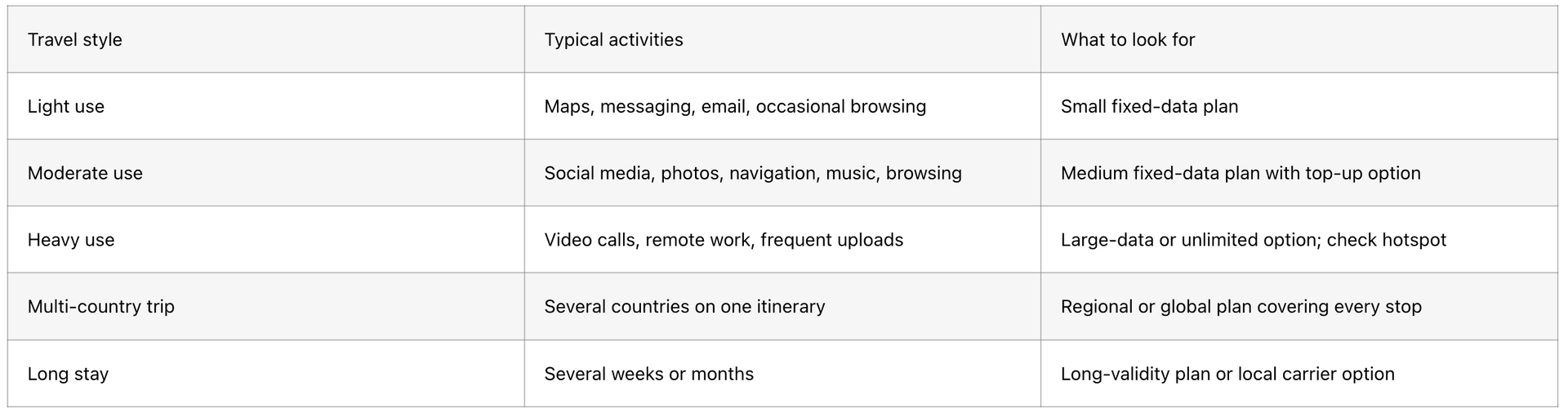
A light traveler who mainly uses maps, messaging, ride-hailing, email, and occasional social media may need far less data than someone streaming video, uploading files, or working remotely. Buying unlimited data can be unnecessary for light use, while a small fixed-data package may be inconvenient for a heavy user.
3. Compare total cost, not the headline price
A plan advertised as “starting at” a low price may include only a small data allowance or short validity. Compare the total cost for the days you need, included GB, top-up prices, and any checkout charges.
4. Check network and speed details
An eSIM brand is not itself the mobile network. Travel eSIM providers partner with local carriers, so performance can vary by destination. Check which networks the plan can use and whether 4G LTE or 5G is supported.
5. Check hotspot, calls, and texts
If you will work from a laptop or share data, verify hotspot support. Also check whether the plan is data-only or includes voice and SMS. People who need a traditional local number may need a different plan or local SIM.
6. Check activation rules before you install
Some eSIMs begin validity when they connect at the destination; others can start counting down upon installation. Airalo’s support information specifically advises customers to check the activation policy before installation.

Is an eSIM Better Than International Roaming?
Not automatically. A travel eSIM can provide a separate prepaid data option, but your existing carrier may already include international roaming or offer a travel pass. Apple recommends checking your carrier’s international options before traveling.
For short trips, compare the total roaming cost with the eSIM cost. Also consider convenience: keeping your primary line active may help with bank verification messages, calls, or services tied to your home number.
How Much eSIM Data Do You Need?
How to Set Up an eSIM Before You Travel

First, confirm that your phone supports eSIM and is unlocked for another carrier. Purchase the plan while you have reliable Wi-Fi, install it according to the provider’s instructions, label it clearly, and review which line is selected for mobile data. Apple notes that travelers can keep their home SIM and use a travel eSIM for data on supported dual-SIM devices.
Do not delete your primary SIM just because you installed the travel eSIM. Before departure, save the provider’s support instructions and check whether the eSIM should remain off until arrival. On landing, select the travel eSIM for cellular data and follow the activation instructions.
Common Travel eSIM Mistakes to Avoid
- Buying before checking that your phone supports eSIM and is carrier-unlocked.
- Choosing by country count without checking your actual itinerary.
- Installing without reading when validity begins.
- Assuming “unlimited” means unrestricted speed, hotspot, or identical network access everywhere.
- Selecting a data-only plan when you need a traditional local number.
- Leaving your primary SIM’s data roaming enabled when you intend to use the travel eSIM for data.
- Waiting until after landing to troubleshoot installation.