Where Is Lithuania Located? Map, Europe Location & Travel Guide
Reading Time: 7 minutes
Lithuania is located in Northern Europe on the eastern shore of the Baltic Sea. It is the southernmost of the three Baltic States: Lithuania, Latvia, and Estonia and shares land borders with Latvia, Belarus, Poland, and Russia’s Kaliningrad Oblast.
Its capital, Vilnius, is located in the southeastern part of the country.
For travelers from the United States trying to picture Lithuania on a European map, look north of Poland and south of Latvia. The Baltic Sea lies to Lithuania’s west, while Belarus lies along much of its eastern and southeastern border. Lithuania’s unique location makes it an ideal destination for discovering historic cities, UNESCO-listed sites, coastal landscapes, and unforgettable Baltic experiences.
Where Is Lithuania on the Map of Europe?
Lithuania sits in the Baltic region of Europe, along the southeastern/eastern coast of the Baltic Sea
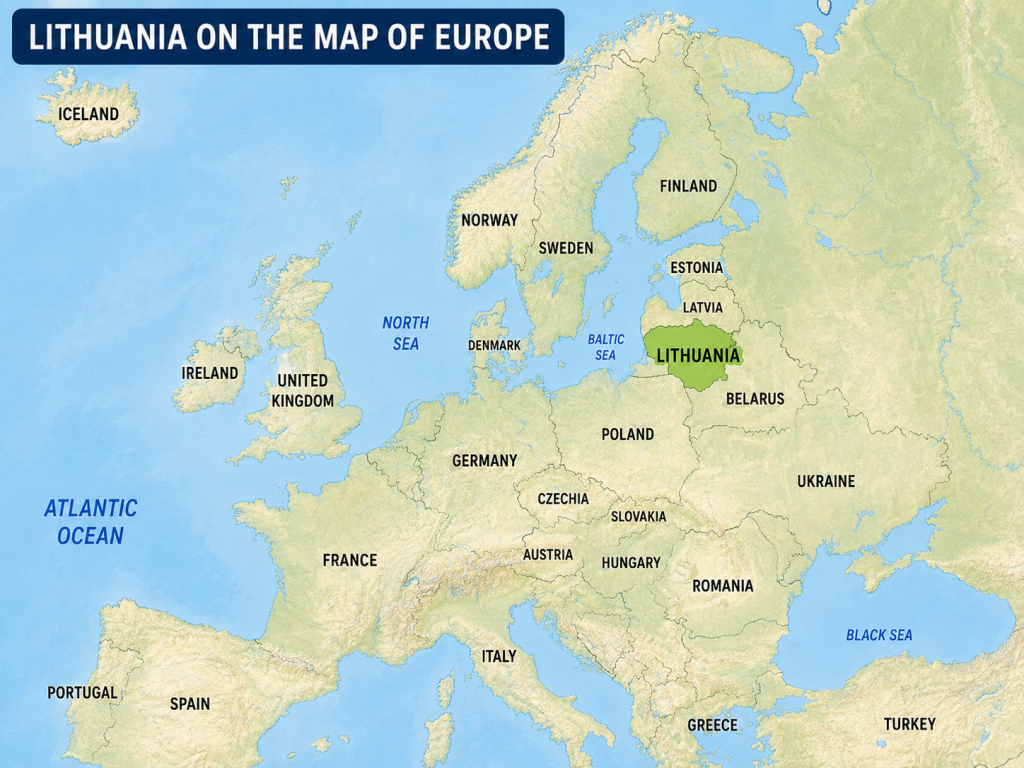
On a map of Europe, Lithuania can be found:
- South of Latvia
- North and northeast of Poland
- West and northwest of Belarus
- Northeast of Russia’s Kaliningrad Oblast
- East of the Baltic Sea
Sweden lies across the Baltic Sea to the northwest, while Estonia is farther north beyond Latvia.
Lithuania’s approximate coordinates are:
54.6872° N, 25.2797° E
Lithuania’s position places it between several parts of Europe and has historically made the country an important crossroads between the Baltic, Central European and Eastern European regions.
Is Lithuania in Europe?
Yes. Lithuania is a European country.
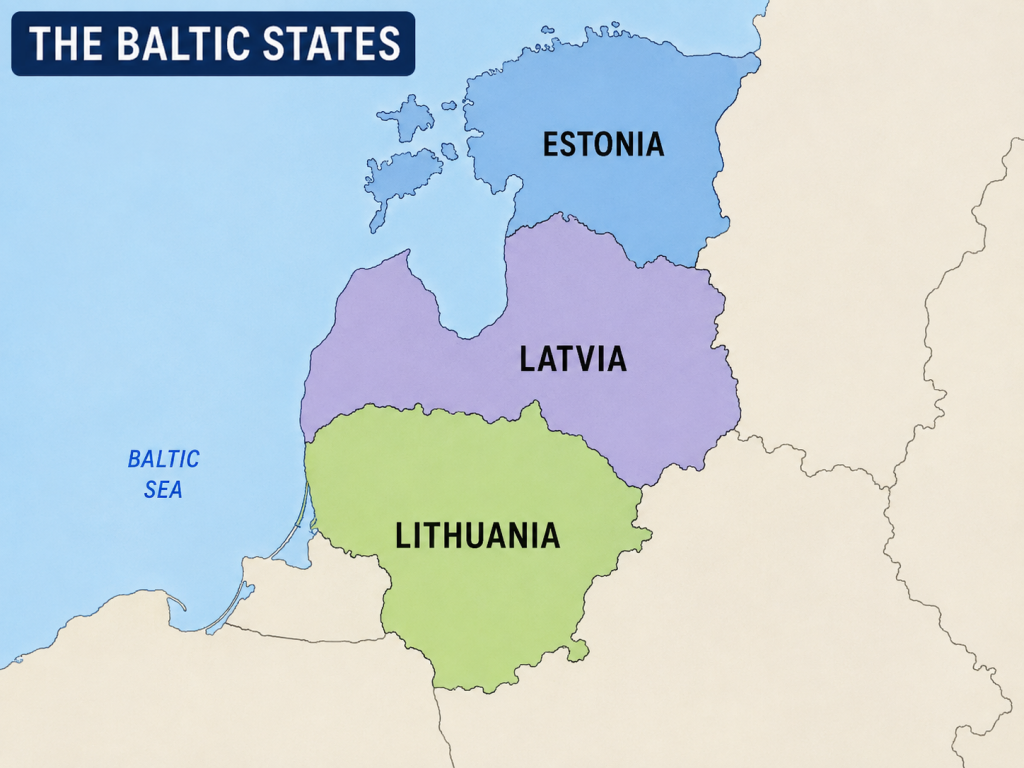
More specifically, Lithuania is one of the three countries commonly known as the Baltic States:
- Estonia
- Latvia
- Lithuania
It is a member of the European Union, NATO, and the Schengen Area, making travel between Lithuania and many other European countries convenient for visitors.
Lithuania is the southernmost of the three.
The United Nations classifies Lithuania within the
Northern Europe sub-region. The country is also commonly described as being in northeastern Europe or the Baltic region.
Where Is Lithuania Located Compared to Other European Countries?
Lithuania’s location makes it easy to understand its position within Europe:
| Location | Lithuania’s Position |
|---|---|
| Latvia | North of Lithuania |
| Poland | South of Lithuania |
| Belarus | East and Southeast |
| Baltic Sea | West |
| Sweden | Across the Baltic Sea |
Lithuania is located close to several popular European destinations, making it a convenient stop for travellers exploring the Baltic region.
Is Lithuania in Northern or Eastern Europe?
This is one of the reasons people sometimes become confused about Lithuania’s location.
Geographically and in current UN statistical classification, Lithuania is grouped with Northern Europe.
You may still encounter descriptions of Lithuania as Eastern European, particularly in historical discussions connected with the Soviet era. “Northeastern Europe” is also commonly used when describing its physical position on the continent.
For travelers, the simplest description is:
Lithuania is a Baltic country in Northern Europe, located on the eastern shore of the Baltic Sea.
What Countries Border Lithuania?
Lithuania shares land borders with four neighboring countries.
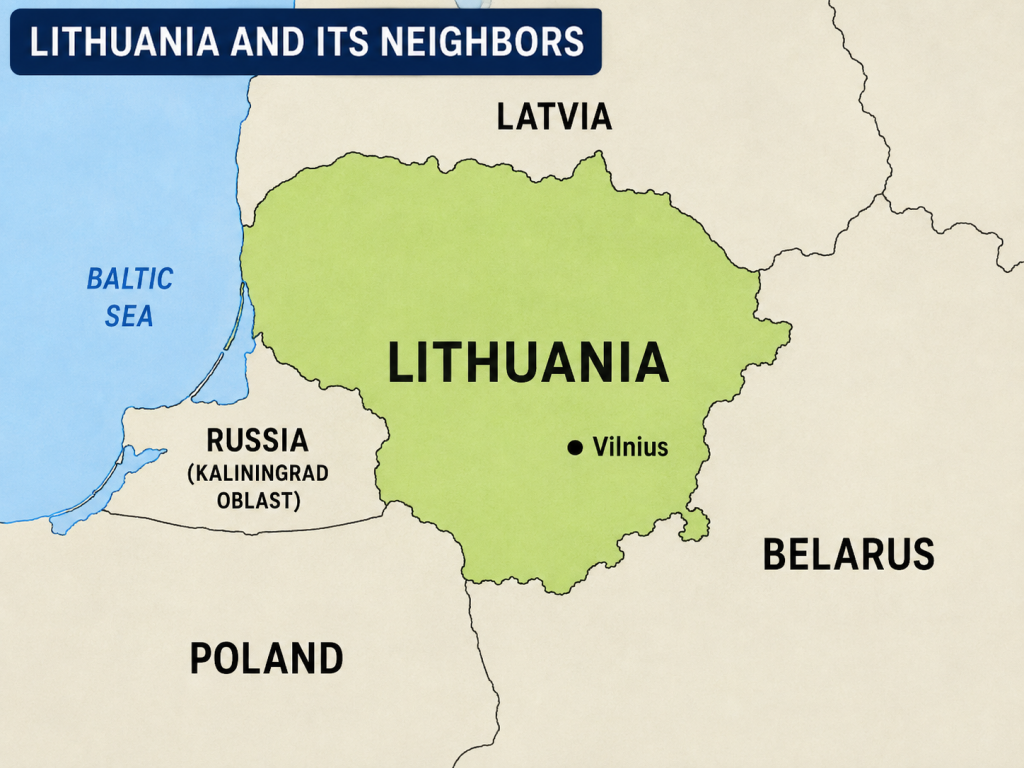
Lithuania shares land borders with Latvia, Belarus, Poland, and Russia’s Kaliningrad Oblast.
Latvia
Latvia lies directly north of Lithuania.
Traveling north through Latvia eventually leads toward Estonia, making Lithuania the southern starting point of the three Baltic States.
Belarus
Belarus borders Lithuania primarily to the east and southeast.
Vilnius is located in southeastern Lithuania and therefore sits much closer to the Belarusian border than Lithuania’s Baltic coastline.
Poland
Poland lies to Lithuania’s southwest.
This border is especially important geographically because it connects Lithuania and the other Baltic States by land with Poland and the rest of the European Union.
Russia’s Kaliningrad Oblast
Lithuania also borders Kaliningrad Oblast, a Russian territory located between Lithuania, Poland and the Baltic Sea.
Kaliningrad is separated geographically from the main territory of Russia.
Together, these borders make Lithuania easy to identify on a European map: look between Latvia and Poland, immediately west of Belarus and beside the Baltic Sea.
What Are the Major Cities Located in Lithuania?
Although Lithuania is a relatively small country, it offers a variety of destinations for travellers.
Vilnius — The Capital of Lithuania
Vilnius is located in southeastern Lithuania and is the country’s capital city.
Known for its UNESCO-listed Old Town, baroque architecture, and vibrant cultural scene, Vilnius is usually the starting point for international visitors exploring Lithuania.
Kaunas — Lithuania’s Cultural City
Located in central Lithuania, Kaunas is known for its historic architecture, museums, and cultural attractions.
The city served as Lithuania’s temporary capital during the interwar period and remains an important cultural destination.
Klaipėda — Lithuania’s Baltic Coast Gateway
Klaipėda is located on Lithuania’s western coastline along the Baltic Sea.
It serves as the gateway to the Curonian Spit, one of Lithuania’s most unique natural landscapes.
Is Lithuania Part of Russia?
No. Lithuania is not part of Russia.
Lithuania is an independent European country.
Today, Lithuania is a member of the European Union, uses the euro, and is part of the Schengen Area. Lithuania joined the EU in 2004 and has participated in the Schengen Area since 2007.
The confusion sometimes comes from Lithuania’s 20th-century history and its proximity to Russia’s Kaliningrad region.
On today’s map, however, Lithuania and Russia are separate countries.
Where Is Vilnius Located?
Vilnius is the capital and largest city of Lithuania.
It is situated in the southeastern part of the country, considerably inland from the Baltic Sea and relatively close to the Belarusian border.
If you are visiting Lithuania from the United States, Vilnius will often be one of the first places you encounter when researching the country because it is Lithuania’s political and cultural capital as well as an important gateway for international visitors.
Other major Lithuanian cities include:
- Kaunas – in central Lithuania
- Klaipėda – on Lithuania’s Baltic coast
- Šiauliai – in northern Lithuania
- Panevėžys – in north-central Lithuania
Is Lithuania a Baltic Country?
Yes. Lithuania is one of the three Baltic States, together with Latvia and Estonia.
From north to south, they are:
Estonia → Latvia → Lithuania
All three are located along the eastern side of the Baltic Sea.
For someone looking at Europe from the United States, Poland is a useful reference point: Lithuania sits directly north/northeast of Poland, while Latvia and Estonia continue north toward Finland.
Does Lithuania Have a Coastline?
Yes.
Lithuania has a coastline along the Baltic Sea on the western side of the country.
One of its most important coastal cities is Klaipėda, Lithuania’s major seaport.
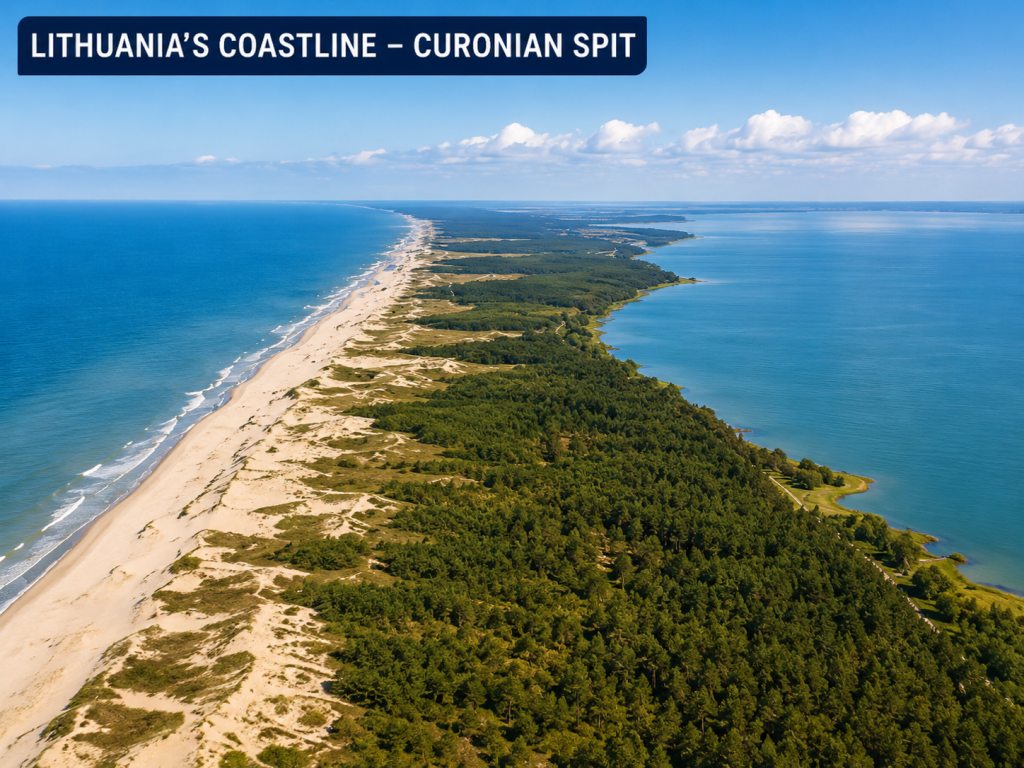
The Lithuanian coast is also associated with the Curonian Lagoon and Curonian Spit, a narrow stretch of sand dunes and forests extending along part of the Baltic coastline. Lithuania has roughly 99 kilometers of coastline when the Curonian Lagoon coast is included in the commonly cited geographic measurement.
How Big Is Lithuania?
Lithuania covers approximately 65,000 square kilometers, or about 25,000 square miles.
That makes it the largest of the three Baltic States by land area.
According to current EU figures, Lithuania has a population of roughly 2.9 million people.
Despite its relatively compact size, the landscape includes forests, lakes, wetlands, rivers, agricultural plains and a Baltic coastline.
What Is Lithuania’s Geography Like?
Lithuania is generally a low-lying country rather than a mountainous destination.
Its landscape was heavily shaped by glaciers and today consists largely of plains, gentle uplands, forests, lakes and wetlands. Its highest point, Aukštojas Hill, reaches only about 294 meters above sea level.
The country’s most important river is the Nemunas, while the Baltic Sea defines much of Lithuania’s western geographic identity.
This compact geography means travelers can experience historic cities, countryside, lakes and the Baltic coast without covering the enormous distances required in many parts of the United States.
Where Is Lithuania Located From the United States?
From the United States, Lithuania lies across the Atlantic Ocean in Northern Europe.
The easiest way to place it mentally is to first locate Poland on a map of Europe. Lithuania is immediately north/northeast of Poland, below Latvia, beside Belarus and along the Baltic Sea.
Vilnius is Lithuania’s principal city for many international travelers, while other popular destinations such as Kaunas, Trakai, Klaipėda and the Curonian Spit can be incorporated into a wider trip through Lithuania.
For American travelers visiting several European countries, Lithuania can also be combined with neighboring Latvia, Estonia or Poland as part of a broader Baltic itinerary.
Why Does Lithuania’s Location Matter for Travelers?
Lithuania’s location makes it particularly useful for travelers who want to experience several Northern European destinations on one trip.
Visitors can combine Lithuania with:
- Latvia and Estonia for a complete Baltic States journey
- Poland for a Baltic and Central European itinerary
- Vilnius, Kaunas and Klaipėda for an in-depth Lithuania trip
- The Baltic coast and Curonian Spit for nature and seaside experiences
Rather than being geographically isolated, Lithuania sits at a crossroads connecting the Baltic region with Poland and the wider European continent.
Why Does Lithuania’s Location Make It a Great Travel Destination?
Lithuania’s location gives travellers access to a unique combination of history, culture, nature, and regional connections.
Gateway to the Baltic Region
Because Lithuania is located between Northern and Central Europe, visitors can easily combine Lithuania with neighboring destinations such as Latvia, Estonia, and Poland.
Many travelers explore the Baltic region through multi-country itineraries that include the three Baltic states.
A Meeting Point of Different Cultures
Lithuania’s location has influenced its history, architecture, traditions, and cuisine.
Visitors can experience a blend of Baltic heritage, European influences, medieval history, and modern culture.
Easy European Travel Connections
As a Schengen Area country, Lithuania provides convenient access for travellers exploring Europe.
Its airports and transportation connections make it an accessible destination for visitors arriving from North America and other parts of the world.
Explore Lithuania With Vytis Tours
Lithuania’s location makes it one of Europe’s most fascinating destinations, combining historic cities, natural landscapes, cultural traditions, and easy access to the wider Baltic region.
Explore Lithuania with Vytis Tours and experience the history, people, and traditions that make this Baltic country unique.
Quick Facts About Lithuania
Continent: Europe
Region: Northern Europe / Baltic region
Capital: Vilnius
Neighboring countries: Latvia, Belarus, Poland and Russia’s Kaliningrad Oblast
Sea: Baltic Sea
Official language: Lithuanian
Currency: Euro (€)
EU member: Yes
Schengen member: Yes
Area: About 65,000 square kilometers / 25,000 square miles
Frequently Asked Questions About Lithuania’s Location
What continent is Lithuania in?
Lithuania is located in Europe, specifically in the Baltic region of Northern Europe.
Where exactly is Lithuania located?
Lithuania is located on the eastern shore of the Baltic Sea, south of Latvia, west of Belarus and north/northeast of Poland. It also borders Russia’s Kaliningrad Oblast.
Is Lithuania part of Russia?
No. Lithuania is an independent European country and a member of the European Union and Schengen Area.
Is Lithuania close to Poland?
Yes. Lithuania and Poland share a land border in the southwestern part of Lithuania.
Is Lithuania close to Estonia?
Lithuania and Estonia are both Baltic States, but they do not share a border. Latvia lies between them.
What are the three Baltic countries?
The three Baltic States are Estonia, Latvia and Lithuania. Lithuania is the southernmost of the three.
What is the capital of Lithuania?
The capital of Lithuania is Vilnius, located in the southeastern part of the country.
Does Lithuania border the Baltic Sea?
Yes. Lithuania has a coastline on the Baltic Sea along the country’s western edge.